Eijiro Ito’s ‘Regarde-moi’
This collection has largely focused on prints made from traditional copper-based photogravure plates. Contemporary practitioners, however, have increasingly turned to photopolymer as an alternative substrate for producing light-based prints in ink. Photopolymer is a light-sensitive synthetic plate that replaces copper in photogravure and related intaglio processes. While the nomenclature surrounding prints made from photopolymer remains unsettled—are they still “photogravures”?—a confusion that has long accompanied photogravure and other photomechanical techniques, the visual syntax of photopolymer prints nonetheless asserts a distinct set of material and tonal characteristics. Eijiro Ito has investigated these qualities extensively, combining papers, inks, and surface finishes with exceptional rigor. His approach is exemplified in his 2021 artist’s book, Regarde Moi.
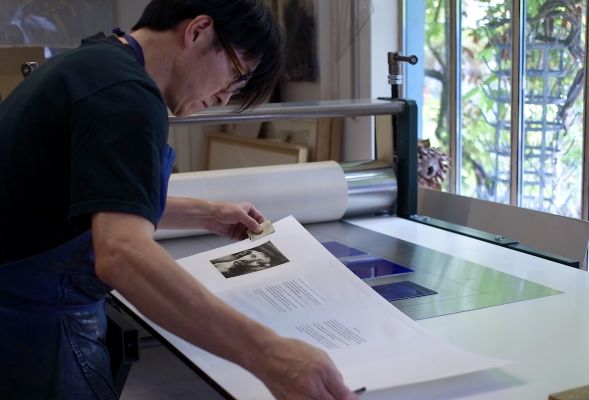
Inside Eijiro Ito’s studio: The making of the artist’s book Regarde-moi.
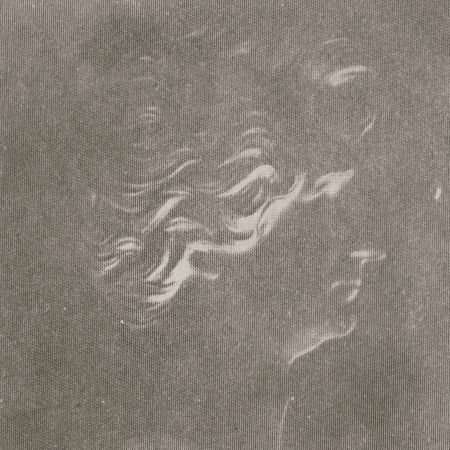
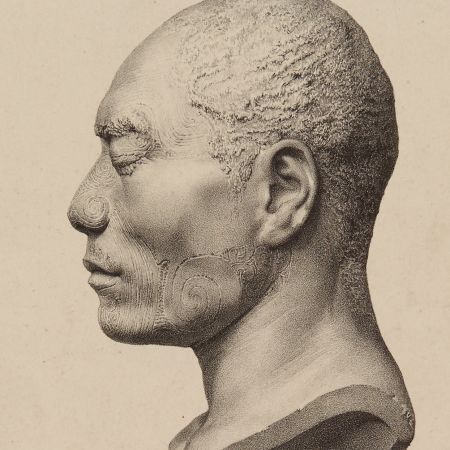
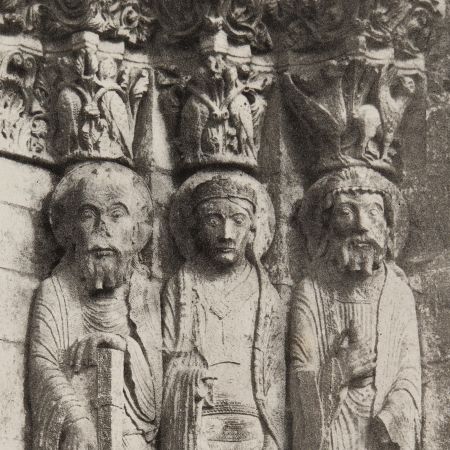
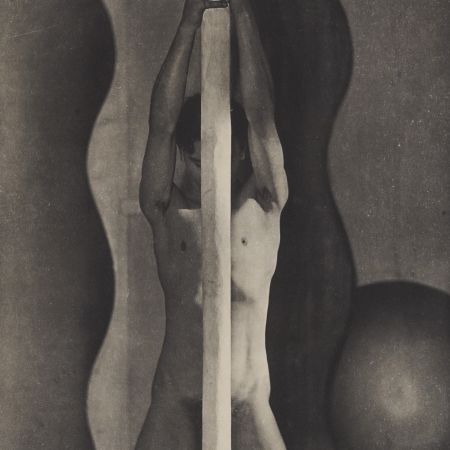
Born in Japan in 1971 and based in France since 1995, Eijiro Ito is a master printmaker whose work investigates the role of reproduction within the context of modern consumer culture. Operating as a flâneur—the observant urban wanderer—Ito navigates the streets of Paris, frequently drawn to the windows of antique galleries. It is within these spaces that he finds a compelling dichotomy between reality and fiction, where objects such as mannequins and statues made of wood, earth, and papier-mâché serve as silent witnesses to the passage of time. His series Regarde moi, created in 2021, emerged from this contemplative practice, turning a lens toward the "face" as both a philosophical enigma and a vessel for collective memory.
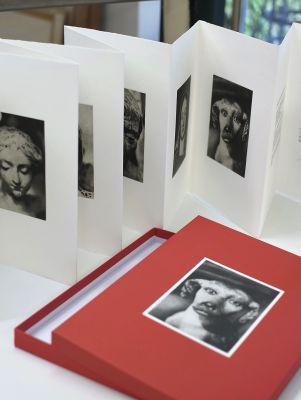
Presentation box and prints of Regarde-moi.
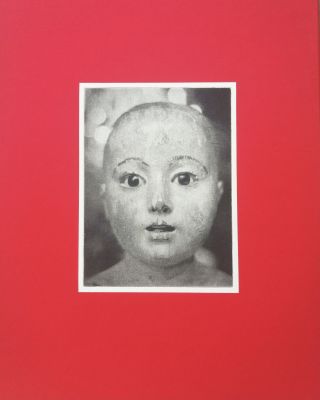
Ito’s work is deeply informed by the philosophy of Emmanuel Levinas, who viewed the face as a gateway to the "Other" and a reminder of our shared humanity. In an era of rapid digital consumption and commercialism, Ito questions whether our gaze has reduced the human experience to a consumable product. By photographing these antique "faces" and translating them into prints, he seeks to reclaim their transcendence. As Ito observes, the camera "freeze-frames" the world, but the act of engraving—the physical creation of fine scratches on a plate—is an action that accesses deeper memories. This process challenges the notion of a "copy," suggesting instead that every reproduction is a new birth, an illustration of the multiple identities held within a single form.
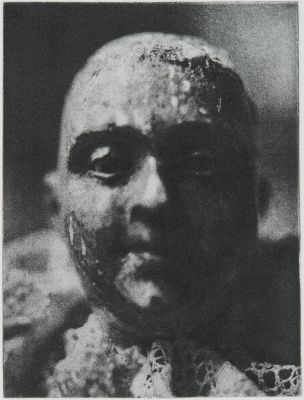
Test print of Regarde-moi No. 4.
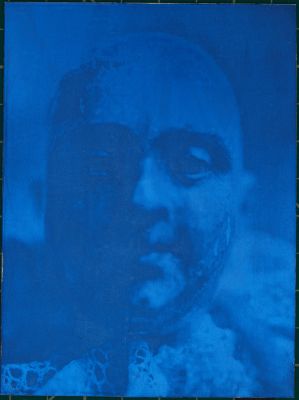
Test plate for Regarde-moi No. 4: Photopolymer film mounted on a zinc plate.
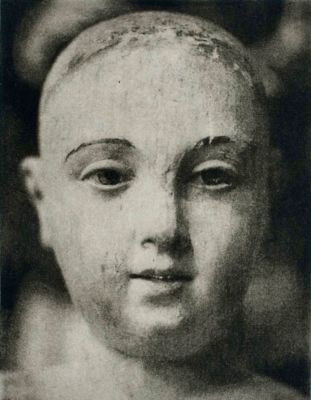
Regarde-moi No. 1.
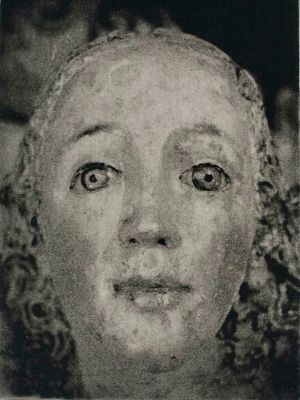
Regarde-moi No. 3.
Technically, Regarde moi serves as a profound exploration of the potential of photopolymer film mounted to steel. While many contemporary photographers and printmakers utilize Toyobo photopolymer plates—aluminum-based plates coated with light-sensitive epoxy that can be printed on directly via inkjet—Ito deliberately chooses a more challenging industrial path. Unlike the Toyobo plates, which can feel detached from the tactile, artisanal feedback of traditional intaglio, photopolymer film requires a refined and rigorous methodology to achieve high-value results. Ito has dedicated years of research to elevating this material, which is often dismissed as a simpler "instant" process, into a sophisticated medium capable of deep tonal nuance.
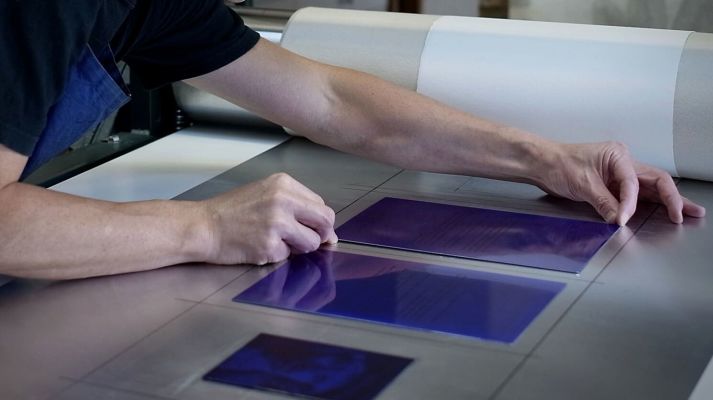
Ito meticulously aligns text and image plates for a single sheet.
A defining characteristic of Ito’s technical signature is his refusal to follow the common pursuit of "velvety" surfaces found in traditional photogravure. Instead, he looks back to a 19th-century lineage where Japanese washi paper and photographic plate-making formed an ideal pairing. In Regarde moi, Ito prints his plates on French BFK Rives paper, laminated with a delicate sheet of Japanese Gampi paper. This chine collé combination introduces a subtle surface reminiscent of raw silk, creating a refined tonal vocabulary that honors his Japanese heritage and the legacy of the Pictorialists.
The reason for using photopolymer film is that it can give new value from the original photographic image. Of course, the rich nuances of the original will be lost. My interest is that the lost nuances bring the viewer's thoughts closer to the more abstract and impactful engraving. Perhaps this is because I am a printmaker, not a professional photographer. And for me, while archival records are important, I think maybe time and vaguely recalled memories are the theme. But I always ask myself what is the right answer…
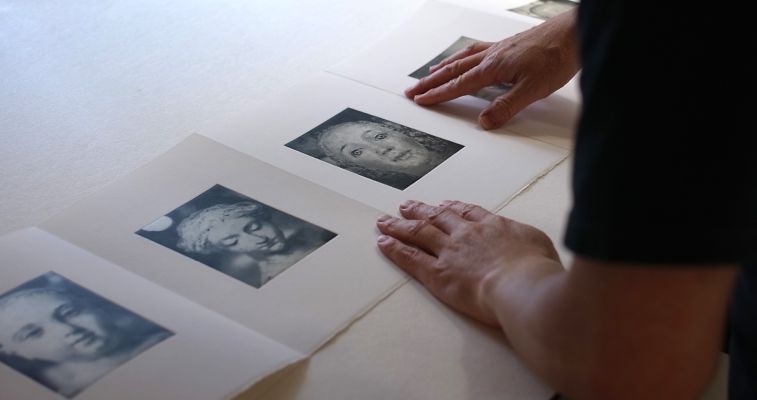
This intentional choice of materials allows the subjects in Regarde moi to reveal their true character—one etched by time. For Ito, this process is an act of honoring the past while posing questions to the future. Each print in this edition—produced in collaboration with Agathe Derieux and printed in the workshop of Sylvie Abélanet—is a trace of the "here and now," calling the viewer to contemplate their own humanity through a gaze that is at once ancient and modern.
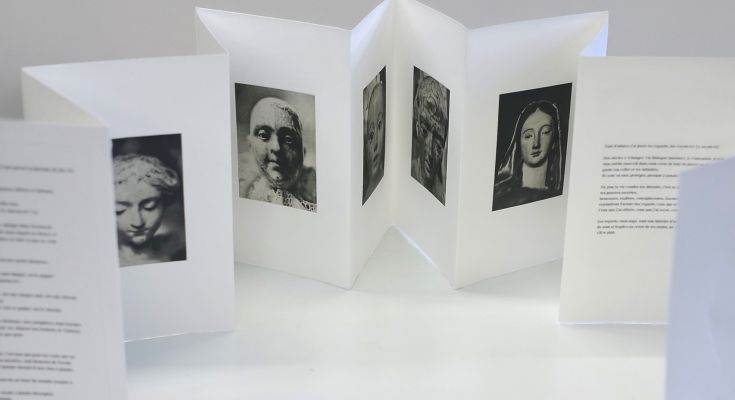
The Regarde-moi artist’s book in its Leporello (accordion-fold) binding.
Art Book: Regarde-moi This exquisite limited edition art book captures a delicate balance between French tradition and Japanese materiality. Edition Details Limited Edition: 15 copies total Artist’s Proofs: 2 copies (épreuves d'artiste) Technical Specifications Plates: 8 polymer film photogravure plates (13 cm × 10 cm) Text Plates: 3 polymer film photogravure plates (25 cm × 15 cm) Cover: Copper plate embossing Dimensions Box Size: 31 cm × 22.5 cm Book Size (Folded): 28.5 cm × 18.5 cm Extended Length: 28.5 cm × 224 cm Binding Style: Leporello (Accordion fold) Paper & Materials A masterful combination of East and West: Each page is printed on premium French BFK Rives (250g) paper, meticulously laminated with Japanese Gampi (雁皮) washi using a traditional paste technique. Presentation Each volume is elegantly encased within the box, wrapped in premium Washi paper using traditional Japanese folding techniques. This thoughtful presentation honors the ritual of unfolding art, ensuring the book is protected and presented with the utmost reverence.