Title
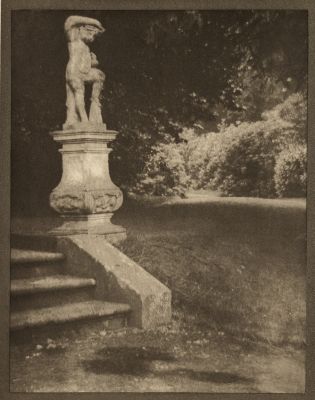
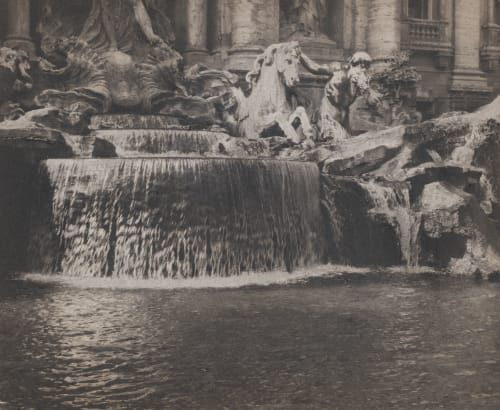
Fountain at Trevi, RomeArtist
Coburn, Alvin Langdon (American, 1882-1966)Key FigureDate
1900 caProcess
PlatinumImage Size
8.9 x 11.4 cm
Platinum print variant of The Fountain at Trevi halftone in Camera Work XXI, 1908.
Alvin Langdon Coburn was among the most technically restless photographers of the Edwardian era, treating both the camera and the darkroom as instruments of deliberate artistic investigation. According to Valentina Branchini’s material study of the George Eastman House holdings, Coburn worked with an arsenal of fifteen lenses — including five Pinkham & Smith semi-achromatic lenses made expressly for him — and progressed from a heavy view camera to a 4×5 reflex as early as 1905–06, enabling greater freedom of movement and angle. He exploited the telephoto lens to compress perspective, describing his images as depending more upon pattern than upon subject matter, and he was equally systematic in the darkroom, mastering platinum, gum-platinum, photogravure, ozotype, three-color gum printing, and the relatively obscure Cristoid film, producing some 40,000 photogravures on his own presses. Branchini’s study shows that Coburn regularly printed the same image in multiple processes, comparing the tonal and textural results across techniques, treating each printing method not as a neutral means of reproduction but as a distinct expressive register in its own right.
It is no surprise, then, that when Stieglitz devoted Camera Work XXI (1908) entirely to Coburn’s work, the issue contained not only six photogravures but six halftones as well. That a standalone platinum exhibition print of The Fountain at Trevi, Rome exists alongside its Camera Work halftone counterpart is consistent with Coburn’s habitual practice of printing the same image across multiple processes — not to reproduce it, but to test what each technique could yield as an independent object. Branchini identifies this most directly in Shadows and Reflections, Venice (1905), where comparison of the letterpress halftone with the original nitrate negative and a gum-platinum print of the same image reveals that Coburn deliberately manipulated the registration of the letterpress printing stages to increase the complexity of the reflections in the canal. In standard halftone printing, precise registration is a technical requirement to be achieved, not subverted; by intentionally offsetting the printing stages, Coburn introduced a controlled misalignment that produced a visual density the straight photograph did not possess. Close comparison of the Trevi platinum print with its halftone counterpart makes the point plainly: even the most industrial of photomechanical processes was, for Coburn, an opportunity — turning the inherent imprecision of a commercial technique into a tool for pictorial achievement.
References
Valentina Branchini, "The Photographs of Alvin Langdon Coburn at George Eastman House: A Characterization Study of Materials and Techniques," George Eastman House, Rochester, August 2009